Here is the counter-intuitive part: the more an AI tool does for you, the less of the result you may legally own. That sounds backwards, but it is now settled US law. The Copyright Office's January 2025 report on copyrightability concluded that works generated solely by AI are not protectable, because copyright requires human authorship — and it specifically held that entering prompts, however detailed, does not by itself make you the author. Two months later the D.C. Circuit affirmed the principle in Thaler v. Perlmutter, and in March 2026 the Supreme Court declined to take the case, leaving that ruling as the law of the land. So a track you generated from a text prompt may not be yours to register, defend, or stop anyone else from reusing.
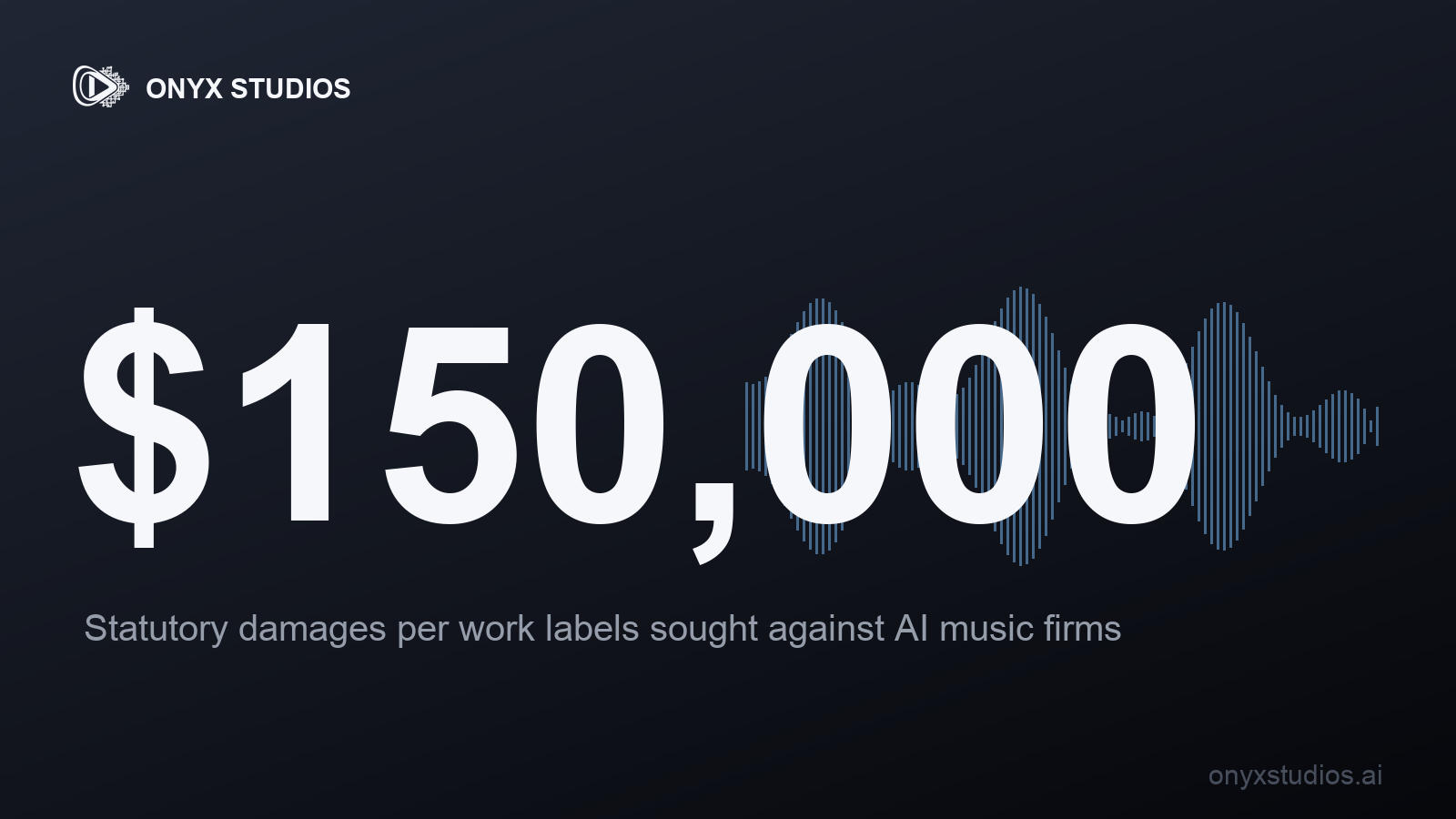
If "no copyright" sounds like a niche worry, the bigger problem sits one layer down — in what the AI was trained on. In June 2024 the major labels, through the RIAA, sued the two best-known AI music services, Suno and Udio, alleging their models were trained on copyrighted sound recordings on a massive scale and could reproduce recognizable hits. The complaints sought statutory damages of up to $150,000 per work infringed — a figure that, multiplied across a catalog of recordings, runs into the billions. These are allegations being litigated, not findings of fact; both companies denied wrongdoing and initially argued fair use. But the suits made one thing unmistakable: the provenance of AI-generated music is contested at the highest level of the industry.
The cases have since started to resolve in ways that quietly reshape the deal you are being offered. In October 2025 Universal Music Group settled with Udio and agreed to build a licensed service together; reporting indicates Udio will pay UMG a per-generation royalty in the range of $0.002 to $0.005, with higher rates for outputs that users commercially distribute. Warner Music followed with a Suno settlement in November 2025, after which Suno dropped its fair-use defense and committed to launching licensed models in 2026. The headline is that the platforms are moving toward paying rights holders. The fine print is that the older, unlicensed models — the ones much of today's "free" output came from — are exactly the ones now being deprecated under legal pressure.
Now read the terms of service, because that is where the ownership question is actually decided for you. Suno's own help documentation states that free-tier users may use generated songs only for non-commercial purposes, and that Suno retains ownership of those songs. Commercial rights attach only to songs created while you hold a paid Pro or Premier subscription — and crucially, a song you made on the free tier does not gain commercial rights retroactively just because you upgrade later. Udio's terms similarly reserve full commercial use for paid subscribers, and grant a non-exclusive license rather than exclusivity. "Royalty-free" on the marketing page and "non-commercial only, we own it" in the contract can describe the very same file.
Even when you pay and clear the commercial-use hurdle, two pieces of risk usually stay with you. First, owning a license to use an output is not the same as owning a copyright in it — and as the Copyright Office made clear, a purely AI-generated track may carry no copyright for anyone to assign. Suno's terms candidly note that it makes no representation that any copyright will vest in your output. Second, and more sharply: these platforms generally do not indemnify you against third-party infringement claims. That means if a rights holder later argues your AI track copied their work, the defense cost and the exposure land on you — the advertiser, the studio, the brand that put the music in front of an audience — not on the tool that generated it.
None of this means generative music is useless. It is genuinely fast, it is great for sketching ideas, and the licensed services arriving in 2026 will narrow the grey zone considerably. The point is more precise: for anything you intend to monetize, broadcast, or attach to a brand, you need to know three things before you press export — who owns the output, what the license actually permits, and who absorbs the risk if a claim arrives. "Free" and "royalty-free" answer none of those questions. A clear chain of rights does.
This is exactly the gap Onyx Studios was built to close. Alongside our voice and dubbing work, our Music studio produces original scores and tracks where every right is accounted for, and Onyx Live Strings records real human string sections — actual players, in a room — delivered with cleared, releasable rights and a written release. That is the structural opposite of the AI ownership grey zone: not a prompt you hope is yours, but a recording you can prove is yours, made by people you can name, licensed in terms you can hand to a client's legal team without flinching.
Our line is "AI-Generated. Human-Perfected." — and on music, the human part is the legal part. If you are scoring an ad, a film, a product launch, or anything that has to survive a rights review, talk to us about a track you can actually own. Buy music from Onyx Studios, and walk away with the recording, the rights, and the paperwork — not just a file and a question mark.