The most striking thing about voice AI is not how much work it is taking away, but how little. The technology can clone a timbre in seconds and read a script in forty languages before lunch, yet the human side of the business keeps growing. The global dubbing and voice-over market was worth USD 4.2 billion in 2024 and is on track to reach USD 8.6 billion by 2034, a steady 7.4% annual climb. If machines were truly swallowing the work, the curve would bend the other way. It doesn't. That single fact should make anyone pause before reaching for the word "replacement."
Look closer and the picture sharpens. Within that same market, human-based voice-over and dubbing still held over 58% of the share in 2024, even as AI tooling matured and got cheaper. AI-powered dubbing is a real and fast-growing category in its own right, on track to roughly double from about USD 1.15 billion in 2025 toward USD 2.56 billion by 2030. But it is growing alongside human work, not on top of its grave. The two curves rise together. That is the shape of augmentation, not extinction.
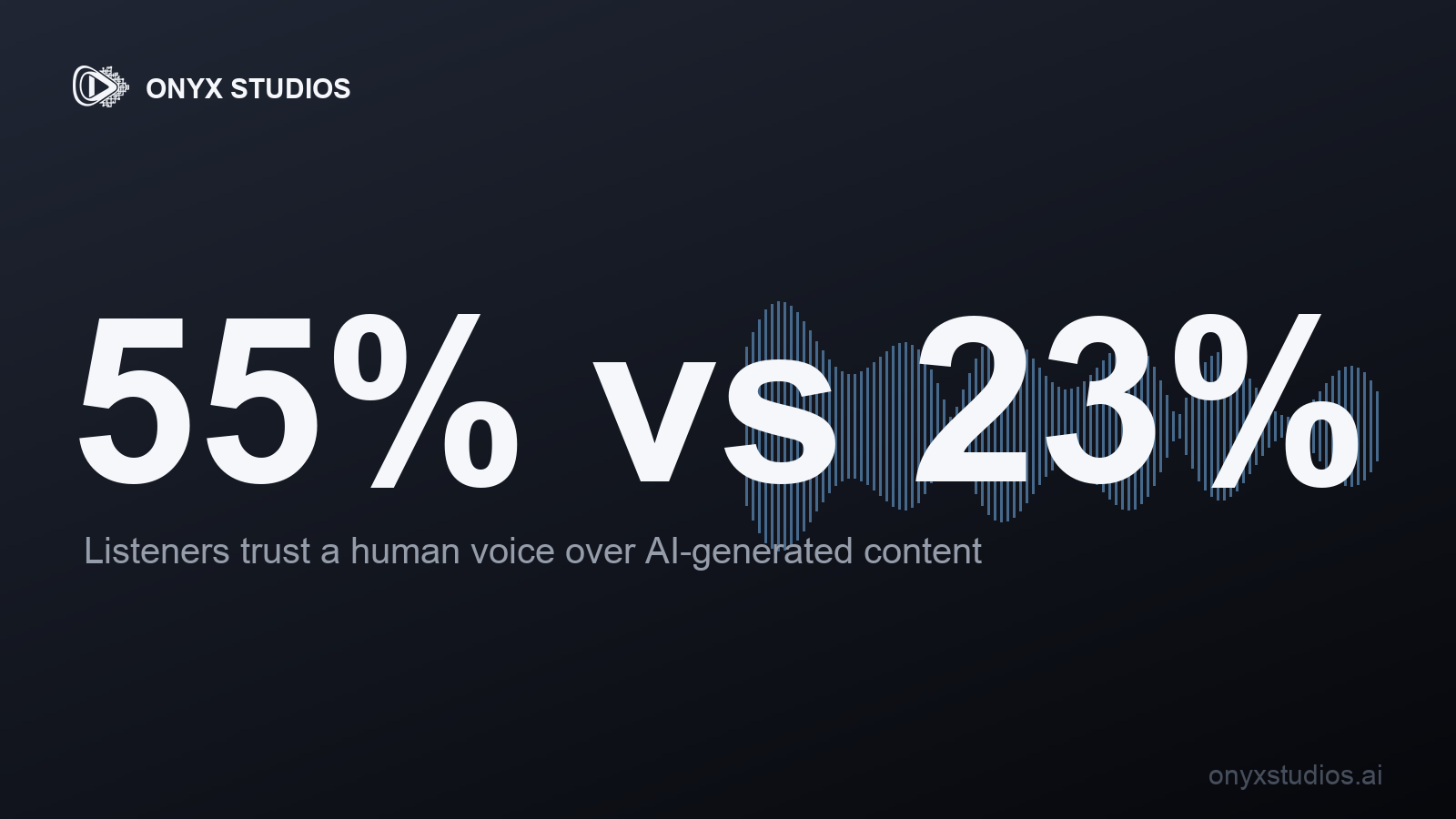
The reason sits in the ear of the listener. When Audacy's Innovation Tracker surveyed adults in June 2024, people were more than twice as likely to trust a human voice (55%) over AI-generated content (23%). Trust is not a luxury feature in voice work; it is the entire product. A narrator's job is to make you believe, and belief is exactly what audiences withhold when they sense a machine on the other end of the microphone. Amazon learned this the hard way in 2024, quietly pulling AI-dubbed Korean dramas after Spanish-speaking viewers complained about flat, robotic voices.
The mechanism behind that trust gap is not snobbery. A skilled performer is making thousands of micro-decisions a synthetic model cannot infer from text alone: where to let a breath fall, which word to lean on, when a laugh should crack rather than ring clean, how a line should sound when the character is lying but trying not to show it. Generative voice is brilliant at the average reading and blind to the meaningful exception. It produces speech; performers produce intention. Audiences may not name the difference, but they feel it, and the survey data is simply that feeling counted up.
There is also a layer machines cannot supply at all: accountability. A voice has an owner, and that owner has rights. The industry settled this in plain terms. After the 2023 strike, SAG-AFTRA secured contracts requiring explicit, informed consent before any studio could create or reuse a digital replica of a performer's voice. Then in 2025, members ratified the Interactive Media Agreement by roughly 95% in favor, locking in consent and disclosure rules for video games and setting elevated minimum rates for real-time, AI-voiced characters. The signal is unambiguous: a voice is not raw material to be scraped. It belongs to a person who must say yes.
This is precisely the world Onyx Studios was built for. We are not a lab betting against people, and we are not a studio pretending AI does not exist. We are both at once. More than 1,500 professional voice actors work alongside our AI systems, and every single delivery—voice, dubbing, or music—is verified by a native speaker before it ships. That is what "AI-Generated, Human-Perfected" means in practice: the machine drafts at the speed clients need, and a human ear catches the mispronounced name, the wrong emotional register, the line that reads fine but lands wrong. The AI is fast. The human is right.
Consent runs through the whole operation, not as a legal footnote but as a foundation. Every AI voice in the Onyx catalog is built from a recording the actor agreed to, on terms the actor understands. We specialize in Taiwan Mandarin and Cantonese across more than forty languages, and we offer Onyx Live Strings—real string sections recorded by human musicians with rights fully cleared. The thread is the same in every studio we run: technology amplifies human talent; it never quietly stands in for it. Augmentation is not a slogan here. It is the operating model.
So will AI replace voice actors? The data answers no, and it answers something more useful than no: the work is shifting toward the parts only humans can hold. If you are a brand, the question worth asking is not whether your voice content was made fast, but whether anyone you trust verified it before it reached your audience. Talk to us about voice, dubbing, and music where a human signs off on every second. And if you are a voice actor wondering where you fit in this future, the answer is at the center of it. Join the Onyx roster—your consent respected, your craft amplified, your name on the work.
Sources
- 1.Market.us — Dubbing & Voice-over Market (USD 4.2B in 2024 → 8.6B by 2034; human-based services >58%)
- 2.Market.us — AI-Powered Dubbing Tools Market (~USD 1.15B in 2025 → 2.56B by 2030)
- 3.Audacy — “Audio: A Beacon of Trust in the Age of AI”, Innovation Tracker, June 2024 (55% trust human vs 23% AI)
- 4.Perkins Coie — How the 2023 SAG-AFTRA & WGA contracts address generative AI
- 5.SAG-AFTRA — Members approve the 2025 Interactive Media (video game) Agreement, ~95% in favor