Type a line of Chinese into almost any generative voice engine and listen closely. The speech is fluent, fast, often startlingly human. But for a Taiwanese ear, something is subtly off — the r's curl a little too hard, syllables blur into one another, the cadence rolls in a way that belongs to Beijing, not Taipei. That tilt toward a mainland sound is real, and it shows up even when you never asked for it. The good news: it isn't destiny. It's a data problem, and data problems can be fixed.
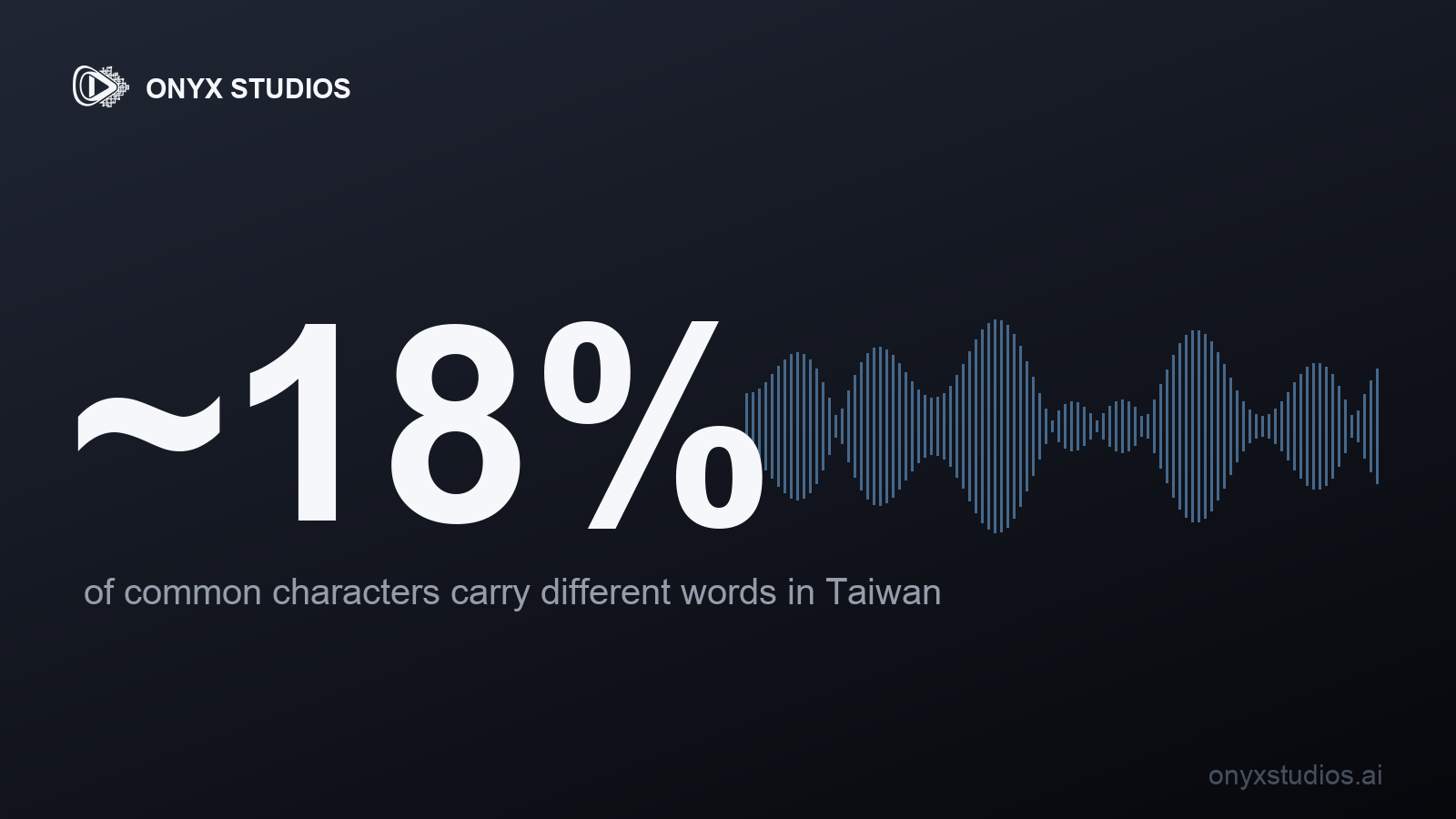
Start with the obvious: the words themselves differ. In Taiwan a video clip is 影片; on the mainland it's 视频. A taxi is 計程車 in Taipei, 出租车 in Beijing. The little gadget under your hand is a 滑鼠 in Taiwan and a 鼠标 across the strait; software is 軟體 versus 软件, the internet 網路 versus 网络. These aren't slang — they're the default register of professional, written, broadcast speech. A 2008 study of the 7,000 most common Chinese characters found roughly 18% of everyday vocabulary differs between Taiwan's Guoyu and the mainland's Putonghua. A voice that says 视频 when your script says 影片 has already broken the spell.
Sound runs deeper than vocabulary. The hallmark of a northern, Beijing-leaning accent is erhua — that rolling -r suffix that turns 哪里 (nǎlǐ) into 哪儿 (nǎr) and gives the speech its fluid, curling momentum. In Taiwan Mandarin, erhua is almost entirely absent: speakers pronounce each full syllable instead. Just as telling is what happens to the retroflex initials zh, ch, sh and r. In textbook Putonghua the tongue curls hard back; in Taiwan those sounds are routinely flattened and softened, often merging toward z, c, s. The retroflex r in particular loses much of its growl. To a native listener, the presence or absence of that curl is an instant tell.
Then there's melody. Taiwan Mandarin tends toward a lower, narrower pitch range and a flatter, gentler intonation, and it leans on the full lexical tone of each syllable where Beijing speech sheds many of them into a light neutral tone. Much of this softening traces back to the deep substrate of Taiwanese Hokkien, which shapes everything from rhythm to sentence-final particles. The result is a Mandarin that feels measured and even-keeled rather than punchy and rolling — a different music, not a worse one.
So why do the models default to the other music? Because that's overwhelmingly what they were fed. The big open Mandarin speech corpora that train modern voice models are built from mainland sources: WenetSpeech4TTS, a benchmark corpus for large speech-generation models, contains 12,800 hours of Mandarin audio, while the widely used AISHELL-3 TTS set is 218 mainland Mandarin speakers across some 85 hours. When the vast majority of the voice a model ever hears is mainland Putonghua, the system does what statistics tell it to: it regresses to that mean. The Taiwan accent isn't rejected so much as quietly outvoted.
Researchers in Taiwan have named the gap explicitly. In early 2025, MediaTek Research and National Taiwan University released BreezyVoice, a TTS system adapted specifically for Taiwanese Mandarin, precisely because general-purpose engines stumble on it — especially on polyphone disambiguation, where the same character takes a different reading in Taiwan than on the mainland. Their work is direct evidence that this isn't a fussy preference but a measurable engineering problem worth a dedicated paper: when the target is Taiwan, a model tuned on everyone-else's Mandarin needs deliberate correction.
This is exactly the gap Onyx Studios was built to close. We're a Taiwan studio — 凡音文化, founded in 2008 — with more than 1,500 professional voice actors and unusually deep benches in both Taiwan Mandarin and Cantonese. Our models aren't asked to extrapolate a Taiwan accent out of mainland data; they're built on the real thing, voiced by talent who grew up speaking it. Then every line is checked by native speaker ears that catch the tells a metric never will: a stray erhua, an over-curled retroflex, a 视频 that should have been 影片, a neutral tone where a full tone belonged. That's what our line means — AI-Generated. Human-Perfected.
If your audience is in Taipei, Taichung or Kaohsiung, that difference is the difference between a voice that sells and a voice that subtly signals you're not from here. Don't take our word for it — let your own ears decide. Hear an authentic Taiwan-accent demo at onyxstudios.ai, and when it sounds like home, you can put it to work the same day.