The voice in that ad sounds warm, confident, unmistakably human. It probably is human — or it was, once, before it became training data. Generative voice AI has a genuinely impressive trick: feed it a few minutes of someone speaking, and it can produce hours of fresh speech in that person's timbre, cadence, and warmth. The speed is real. So is the blind spot hiding inside it — the question of whether the person whose voice it learned ever said yes.
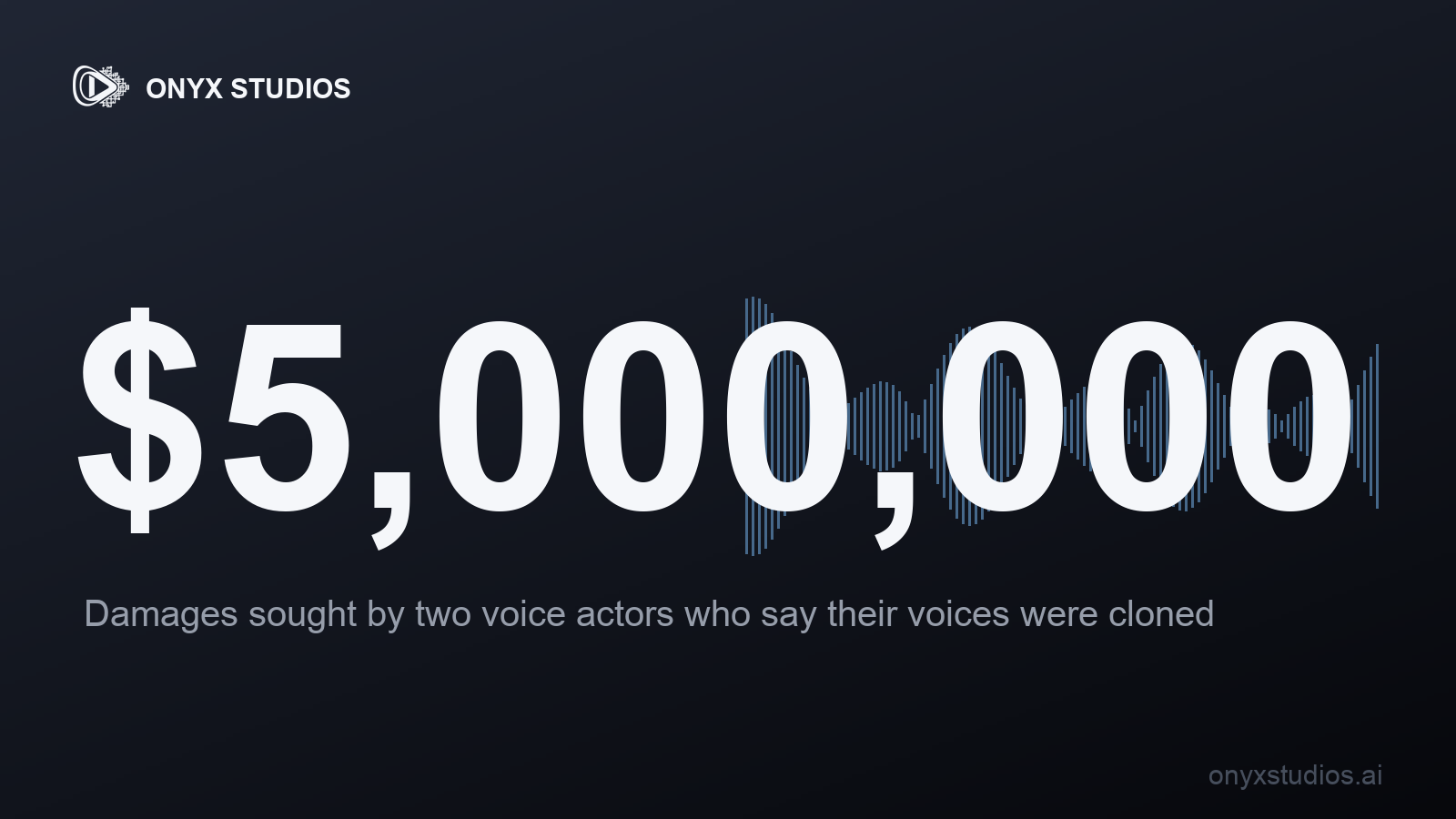
Ask Paul Lehrman and Linnea Sage. The two professional voice actors say they were hired through Fiverr for what they were told were modest, low-stakes gigs — a research project, some test radio scripts. They allege the clients were actually employees of an AI text-to-speech company, Lovo, which used the recordings to build synthetic voices it then sold to subscribers under the invented names "Kyle Snow" and "Sally Coleman." Lehrman says he later stumbled on his own voice in YouTube videos and podcasts he had never recorded. In their proposed class action they sought at least $5 million in damages, and in July 2025 a federal judge in the Southern District of New York let their right-of-publicity, breach-of-contract, and consumer-protection claims proceed, while dismissing the trademark and most copyright claims. The case is alleged and ongoing; no liability has been established. But the shape of the harm is no longer hypothetical.
Even when no recording is copied at all, resemblance alone can blow up. In May 2024 OpenAI demonstrated a ChatGPT voice it called "Sky," which listeners immediately compared to Scarlett Johansson's performance in the film Her. Johansson said publicly that OpenAI had asked her to voice the assistant, that she had declined, and that she was "shocked" and "angered" to hear a voice "so eerily similar" to her own. OpenAI maintained that Sky was a different actor cast before any outreach to her — and pulled the voice within days, after her lawyers sent letters. No copying was ever proven. That is precisely the point: the legal and reputational exposure attached to the mere impression of an identity, not to a stolen file.
How common is the underlying carelessness? Proof News, the investigative outlet founded by Julia Angwin, put eight commercial voice-cloning tools to the test in 2024 and reported that most of them made little or no effort to confirm that the voice being cloned belonged to a consenting human at all — many asked for nothing more than a checkbox. The National Association of Voice Actors has spent the last two years warning that voices are routinely cloned, sold, and used far beyond anything their owners agreed to, and Equity's legal adviser has described a "troubling pattern" of performers who lent their voice to one project only to find it commercialized somewhere they never sanctioned. Consent, in this market, has too often been an honor-system tickbox rather than a verified fact.
Lawmakers have started to close the gap. In March 2024 Tennessee enacted the ELVIS Act — Ensuring Likeness, Voice, and Image Security — the first state law to explicitly extend personality rights to a person's voice, covering "the actual voice or a simulation" and taking effect that July. California followed with AB 1836 and AB 2602, restricting digital replicas of performers living and dead. And in Congress, the bipartisan NO FAKES Act, reintroduced in 2025, would for the first time create a federal right against unauthorized digital replicas of a person's voice or likeness, with takedown duties for the platforms that host them. The legal weather is shifting fast — and it is shifting toward the people whose voices got used without a yes.
Here is the part buyers tend to miss: the risk does not stay with the tool vendor. When you run a campaign, the synthetic voice in it sits on your brand, in your channels, attached to your name. If that voice was learned from a recording the speaker never licensed — or merely resembles a recognizable person too closely — the exposure can flow downstream to the advertiser and the agency, not just the AI company that generated it. Provenance, in other words, is not a back-office detail. It is the difference between an asset you own and a liability you rented. And under most voice-cloning workflows, the buyer has no way to prove where the voice came from, because the vendor itself often never checked.
This is exactly the gap Onyx Studios was built to close. Every voice in our library starts with a real person who walked into a session, recorded with explicit authorization, and signed a buyout contract that lives on file. We do not scrape, we do not repurpose a "research" recording into a product, and we do not ship a voice that merely sounds like someone famous. Our model pays and credits the human behind the voice — and then a native speaker verifies every delivery before it reaches you, which is what our line "AI-Generated. Human-Perfected." actually means in practice. The speed of generative voice, without the borrowed-identity blind spot underneath it.
So two invitations. If you are a voice actor, this does not have to be a story about your voice escaping your control — come build with us on terms that start with your consent, your contract, and your name on the credit and the cheque. And if you are a brand or an agency, ask the one question the lawsuits keep coming back to: can your voice supplier prove the person behind the voice agreed? When the answer is a signed contract on file rather than a checkbox, you stop renting risk and start owning an asset. That is the provenance we can stand behind — and the kind worth standing on.