The counter-intuitive part of modern dubbing is that translating a video is no longer the hard part. Feed a clip to an AI dubbing pipeline, pick ten target languages, and you can have ten voiced, lip-synced tracks back before lunch — a job that traditionally booked studios, voice actors and engineers for weeks. The speed is genuinely astonishing. The trap is assuming that fast and finished are the same thing. They are not, and exactly one step in the workflow decides which one you actually have.
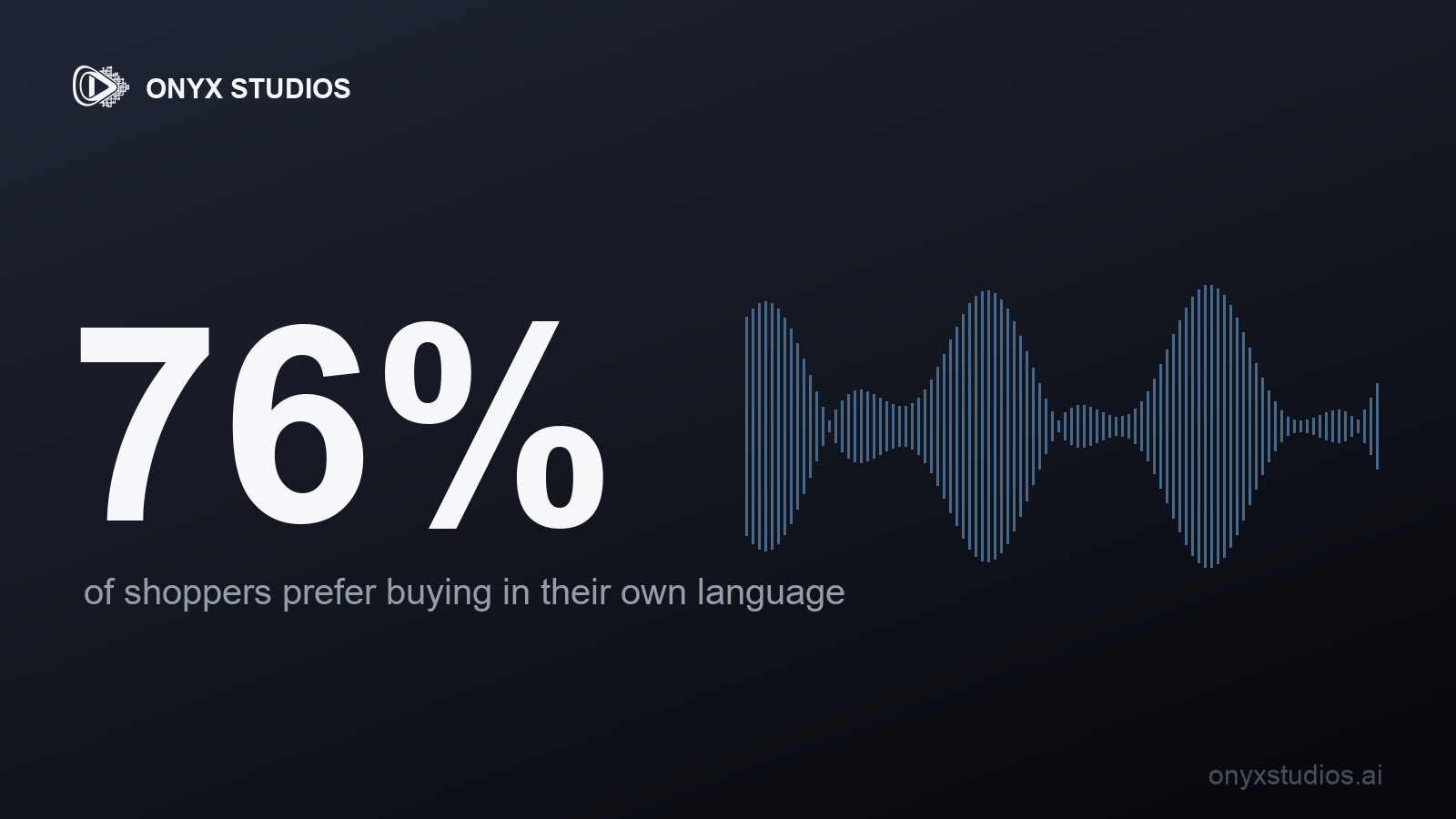
It is worth being clear about why anyone bothers dubbing in the first place, because the data is blunt. In CSA Research's survey of 8,709 consumers across 29 countries, 76% said they prefer to buy products with information in their own language, and 40% will never buy from sites in another language at all. Language is not a finishing touch on a market; for nearly half of it, language is the gate.
The flip side is upside, and it shows up the moment you actually localize. YouTube reported that creators who added multi-language audio tracks saw, on average, more than 25% of their watch time come from views in a video's non-primary language — with channels like Jamie Oliver's seeing viewership roughly triple. Preference is regional, too: dubbing dominates in much of Latin America and continental Europe while subtitles win in the US and parts of East Asia, so reaching everyone means meeting each market in the form it actually wants. None of this is surprising once you've seen the localization market itself, valued at several billion dollars and growing at a healthy clip year after year.
So how does the AI version actually run? It begins with a clean transcript of the source — every line, with its timecode — because the whole pipeline is only ever as accurate as the words it starts from. That transcript is then translated, but good dubbing translation is not the same as document translation: a line has to carry the meaning and fit the breath, the pacing and roughly the on-screen mouth movements, which often means rewriting rather than rendering word for word. From there the translated script is voiced, either by a text-to-speech model or by cloning the original speaker so the dubbed voice keeps the same timbre and emotional color across languages.
The last technical stage is timing. Each generated line gets stretched, compressed or nudged so it lands inside the original gaps and, where it matters, lines up with the lips on screen. Tighten this loop end to end and the economics change completely: buyers interviewed for the Slator 2025 AI Dubbing Report described rates up to 80% lower than traditional dubbing, which is what turns a library of videos that was simply too expensive to localize into something a mid-sized team can ship across ten markets at once.
And then there is the step almost every fast pipeline quietly skips. An AI dub can be fluent and confidently wrong in the same breath: a polished line that flips a number, mangles a brand name, picks the wrong reading of a character, or lands a perfectly natural sentence that no native speaker would ever actually say. None of these failures look like errors on a waveform. They sound fine. They are only catchable by an ear that grew up in the language — and that ear is precisely what an automated pipeline does not have.
This is the gap Onyx is built around. Every language we deliver passes through a native speaker who actually speaks it, drawn from a roster of more than 1,500 professional voice actors, before a single file ships. They are listening for the things models miss: the polyphone read the wrong way, the regional accent that doesn't match the market, the idiom translated literally, the brand term that should never have been touched. It is the difference between a Taiwan Mandarin track that sounds like Taiwan and one that drifts into a mainland cadence — the kind of slip that is invisible to software and glaring to the audience you are trying to win.
That review is not friction bolted onto a fast process; it is the step that converts speed into something you can actually broadcast. AI does the heavy lifting that used to take weeks, and a native speaker does the judging that no model can fake — across Taiwan Mandarin, Cantonese and more than 40 other languages. AI-generated, human-perfected, on every track.
If you have a video, a course library or a campaign waiting on ten language tracks, this is the moment the cost of staying monolingual is higher than the cost of fixing it. Send us the source and the markets you want, and we will dub it — fast where AI is strong, checked where only a native ear will do. Buy dubbing from Onyx, and ship in every language as if it were the first.